Tussock Moon feature: A companion can read the night. Score 8.8.
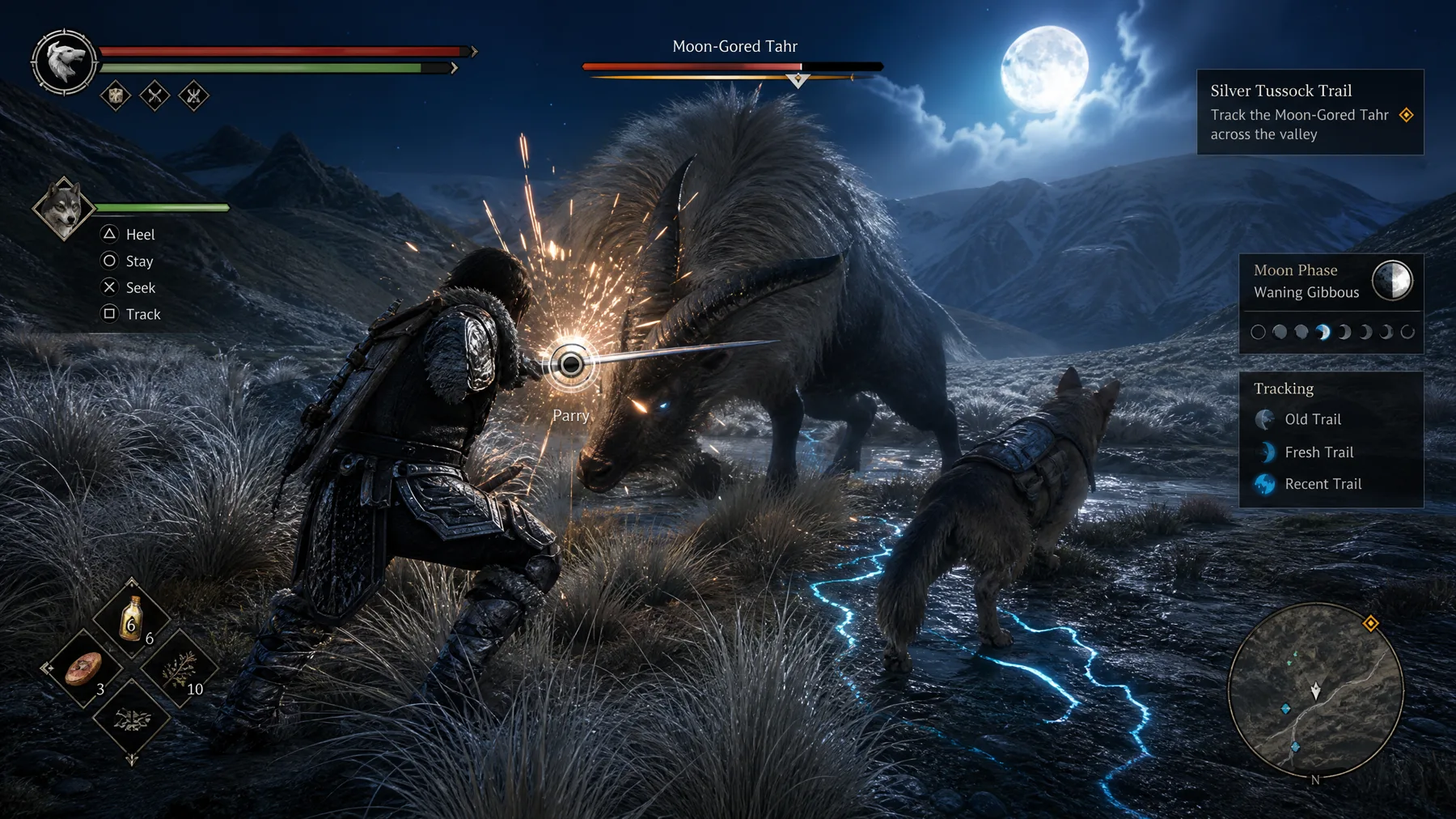
Under a cold moon, steel on chitin sings as the warrior catches a lunging wight on the flat of their blade. Sparks arc, posture gauges flare, and the companion kneels in the tussock, chalking a luminous sigil over fresh claw marks. The HUD is busy but readable: a clean lunar phase dial, stamina and posture bars, and a compact row of companion commands. It is the clearest snapshot of what Tussock Moon actually is — a measured, third-person action RPG about timing, tracking, and letting the night inform your next move.
Parry, posture, and the rhythm of defence
Combat turns on posture damage more than pure hit-point shaving. Well-placed parries chip away at an enemy’s poise until their stance buckles, exposing them to a visceral riposte. The window is fair at 60 frames per second — generous enough to feel learnable, tight enough that panic mashing will see your guard eaten and your stamina broken. Light attacks nudge posture while heavy blows and jump strikes are the breakers; charged heavies can overcommit, but if you bait a beast’s red-tell slam and catch it with a perfect parry, you will watch its posture bar shatter like ice.
There is room to turtle, but shields do not magic away risk. Blocking converts a portion of health into grey damage, recoverable by counter-attacking before you are tagged again. Dodges carry brief invulnerability, yet the game wants you to stand your ground, read tells, and use the counter-guard to keep pressure on an enemy’s stance. Weapon skills add spice: a spear’s sweep that drains posture along a line, a cleaver’s hook that punishes retreat, and lunar rites that trade stamina for an arcing flash that interrupts jumpers. All of this is readable via the HUD’s posture overlay, which tracks both sides in a common metre so you always know who is closer to crumpling.
Lunar-phase behaviour that matters
Tussock Moon’s headline trick is that everything cares about the phase overhead. Each region has an eight-phase cycle that shifts enemy behaviour, resistances, and even their patrol routes. Gloam-wolves slip into ambush paths at first quarter and are easier to startle; hollowed wayfarers glow brighter near full, signalling wider parry tells but adding chip damage to their thrusts. Your own lunar rites reroll on the dial too: new boons unlock at waxing phases, while waning phases dull your burst but improve stamina regeneration. It never feels like a gimmick because the rules are consistent and clearly telegraphed by that HUD moon-dial and subtle changes in sky colour and soundscape.
Time advances as you travel, rest, or burn a rare moonglass to lock a phase for a short span. Bosses do not hard-gate to a specific moon, but you will find advantages: a chitin brute that barely flinches at new moon is posture-prone during gibbous. The design invites planning rather than savescumming — check the dial, decide whether to hunt now or track until the next evening, and tailor your build accordingly. The cycle also folds into exploration. Some doors carved with lunar knots only open on waxing nights, and one valley’s air currents invert under a harvest moon, exposing a ridge-top shortcut. It is systemic, not script-heavy, and it lets the world breathe.
Tracking, taught by a patient companion
Your companion is more than a lantern with legs. Tracking is a verb here, and the AI partner is teacher and tool. Tap the command wheel and you can mark fresh spoor, tag a direction of travel, or ask for a quiet lure. The companion will kneel and sketch a chalk sigil over a footprint cluster, then gesture toward the next trail with a beam of soft blue. Trails have flavour — scuffed tussock suggests hurried prey, deep heel marks reveal a limping brute, and blood flecks hint at a short pursuit — and the companion calls those differences out aloud and in captions.
Commands are simple but layered: Mark (pins a trail node and populates your mini-map), Distract (throws a whistle pebble to pull one enemy), Hold Light (keeps the lantern steady to reveal phase glyphs), Harry (short bow burst that builds posture without big damage), and Mend (a slow, interruptible heal). Each has a cooldown tied to the companion’s morale, which in turn rises when you fight cleanly and falls when you ignore their calls. You can set behaviours too — Bold, Cautious, or Scout — and upgrade perks like faster track marking or a second lure charge. The best fights feel like duets: you bait a swipe, the companion harriers to tip posture, you nail the parry, and the riposte lands as they call “Now!”
“We do not chase the dark. We read it.”
Regions built for loops, not bloat
Rather than an endless sprawl, the game offers five broad regions stitched by mountain passes and tide-cut inlets. Each hub has a lodge, a forge, and one or two ritual rooms where you can bank progress, respec, and set a watch to pass time. Side hunts grow naturally from the tracking system — notice an odd scrape on a bridge rail, follow it to a nighttime ambush, come back at a different phase to catch the pack leader out of position. Dungeons are tighter loops focused on posture puzzles: stagger the shield wall to bounce a shockwave down a corridor, or keep your lantern steady over a chittering floor while your companion marks safe plates. The structure encourages revisiting without padding; shortcuts open, phase-locked doors create light backtracking, and field bosses patrol on rotating nights so returns feel purposeful.
Build variety with lunar leanings
Three core attributes, Strength, Finesse, and Insight, drive your damage, posture impact, and lunar rite potency. Weapons cover spears, blades, axes, and staves, each with two art slots for skills or rites. Armour weight changes your posture stability and recovery rate; running heavy feels secure under pressure, but light kits regain posture faster and sprint further on a small stamina budget. Runes socket into gear to tilt playstyles: Crescent runes raise parry timing leniency during waxing; Waning runes refund stamina on riposte; New runes convert a chunk of posture damage into bleed. Respeccing is available at lodges for a modest cost, encouraging experimentation.
Crucially, the companion has their own tree. You can spec them towards control (longer Distract, stronger Harry posture build) or support (Mend on move, lantern radius). Builds feel expressive without overwhelming menus, and phase-aware augments mean a sword-and-board defender can moonlight as a mobility striker by swapping in rites tuned to the current night. There is no wrong answer, just different rhythms to learn.
Performance modes and feel on each platform
Responsiveness sells this combat, and the console modes are sensibly tuned. On PS5 and Xbox Series X you get a crisp 60 fps Performance mode at 1440p upscaled, or a 4K Quality mode at 30.