
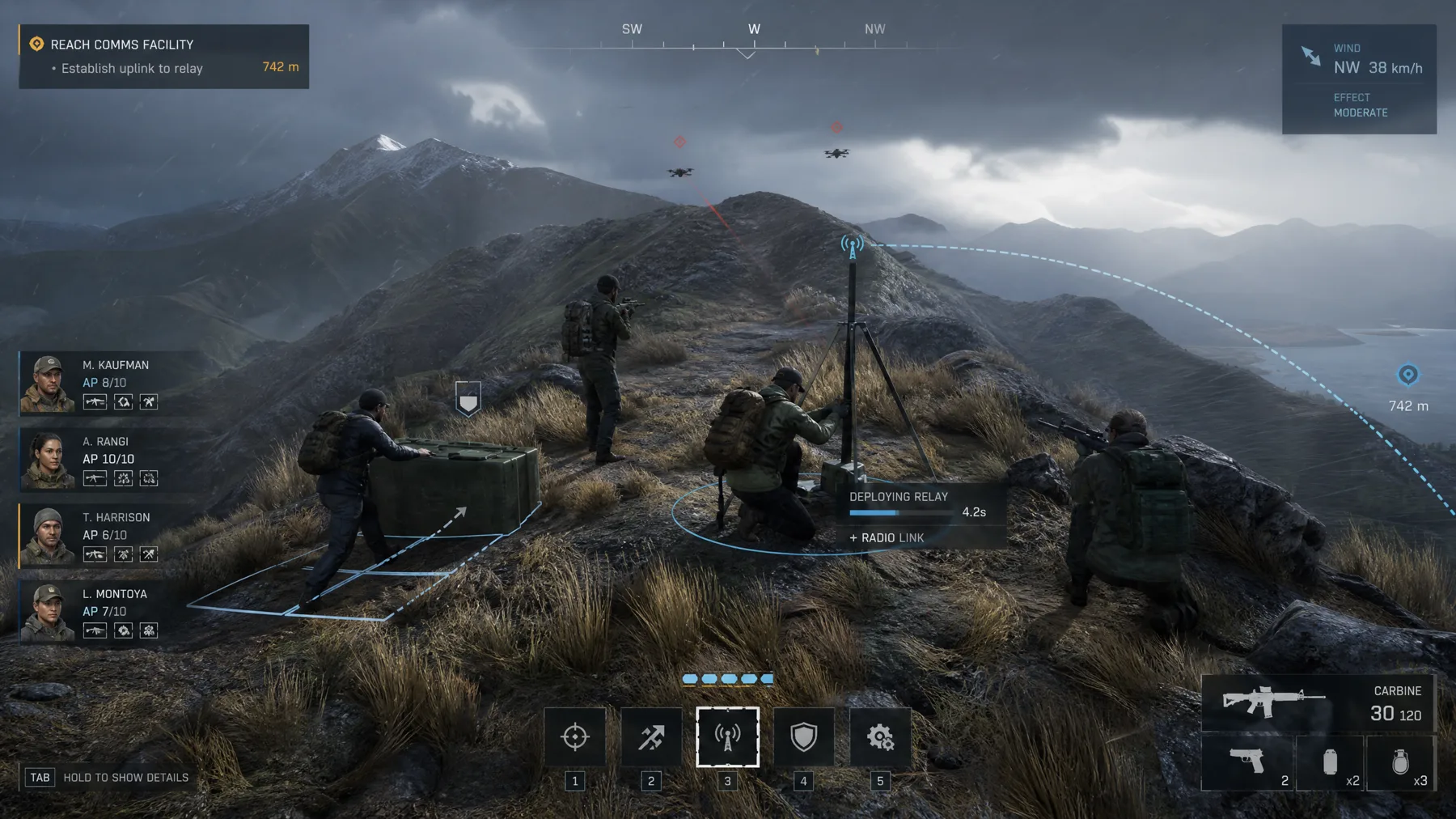
The stormy alpine ridges of Signal Ridge offer no sanctuary for the disorganised. As the wind howls across the craggy peaks and the snow obscures your squad's line of sight, the true enemy isn't just the opposing forces—it's the environment and the limits of your own communication network. In this squad-based tactical game, available on PC, PlayStation 5, and Xbox Series X|S, the battlefield is defined by your ability to maintain a connection. When the radio cuts out, your tactical options dwindle, making every push forward a calculated risk. It is a brilliant, high-stakes approach to the genre that demands meticulous planning and rewards adaptable thinking.
The Lifeline of the Command Radius
At the core of Signal Ridge is its innovative turn structure, which is intrinsically tied to your communication network. Unlike traditional tactics games where units operate with absolute autonomy regardless of their position, your four-person squad must remain within the command radius to function at full capacity. This radius is visualised as a series of pulsing radio arcs on your HUD, originating from your primary communication node. As long as a unit is within this zone, they have access to their full complement of action points and can coordinate complex manoeuvres with their squadmates.
Step outside this radius, however, and the reality of isolation sets in. Units operating in the dark zone suffer severe penalties to their action points and morale. They can no longer receive coordinated support, and their tactical options are reduced to basic survival actions. This mechanic forces you to think of your squad not as independent operators, but as a tethered network. Pushing a sniper to a high vantage point might offer a perfect shot, but if that position is beyond the radio arc, they might find themselves pinned down and unable to react when the enemy flanks.
Extending the Network: Radio Relays
To overcome the limitations of the command radius, Signal Ridge introduces the concept of deployable radio relays. These devices act as vital extensions of your network, pushing the boundaries of your communication arcs further into hostile territory. Deploying a relay is a tactical decision in itself. It costs valuable action points and leaves the deploying unit temporarily vulnerable, but the payoff is a broadened zone of control.
The interplay between advancing your units and leapfrogging your relays forms the strategic backbone of every mission. You must constantly evaluate whether to push a unit forward into the unknown or spend a turn solidifying your network. The enemy AI is acutely aware of this dependency and will actively target your relays, attempting to sever your lifelines and isolate your forward units. Protecting these fragile nodes becomes just as important as securing the objective.
Exposure and the Elements
The environments in Signal Ridge are breathtakingly hostile. The map design leans heavily into verticality and treacherous terrain, demanding careful navigation. The HUD provides crucial information not just on enemy positions, but on environmental factors like wind direction and exposure. The wind mechanics are particularly impactful, affecting the trajectory of projectiles and the propagation of sound, meaning a well-placed shot can easily be thrown off course by a sudden gust.
Exposure is a constant threat. The harsh alpine weather saps the morale of units caught out in the open. A unit's morale acts as a secondary health bar; if it drops too low, they may panic, lose action points, or break cover entirely. Managing exposure means constantly seeking shelter, not just from enemy fire, but from the biting cold and relentless wind. This adds a layer of urgency to your movements, as lingering in the open for too long can be just as deadly as a sniper's bullet.
Shaping the Battlefield: Movable Cover
When natural cover is scarce, Signal Ridge allows you to bring your own. The ability to deploy movable cover is a game-changer, transforming exposed ridges into defensible strongpoints. This cover isn't indestructible, but it provides a crucial buffer against enemy fire and the elements. Deploying it requires action points and careful positioning, but a well-placed barricade can completely alter the flow of a firefight.
The tactical depth of movable cover is immense. You can use it to create safe corridors for advancing units, block enemy lines of sight, or establish a fortified fallback position. The dynamic nature of the battlefield means that cover is never permanent. An explosive charge or a sustained barrage can shatter your defences, forcing you to adapt on the fly. This fluidity keeps engagements tense and unpredictable, rewarding players who can think several steps ahead.
Performance, Controls, and Accessibility
Transitioning a complex tactical game to a controller can be fraught with difficulties, but Signal Ridge handles it with aplomb. The controller support on PS5 and Xbox Series X|S is intuitive, utilising a radial menu system that makes selecting actions and navigating the UI feel natural and responsive. The PC version offers robust keyboard and mouse controls, with fully customisable keybinds for those who prefer a more traditional setup.
Performance is generally excellent across all platforms. The PC version offers a wealth of graphical options, allowing you to tailor the experience to your hardware. On the current-generation consoles, the game targets a smooth 60 frames per second, ensuring that the camera panning and unit animations remain fluid even when the screen is filled with particle effects from the stormy weather. There are occasional minor frame drops during particularly explosive sequences, but they are rare and do not detract from the overall experience.
In terms of accessibility, Signal Ridge offers a comprehensive suite of difficulty options. Rather than a simple easy-normal-hard toggle, you can granularly adjust aspects of the game, such as enemy AI aggressiveness, the severity of exposure penalties, and the fragility of your radio relays. This allows players of all skill levels to find a balance that provides a satisfying challenge without becoming overwhelming.
A Tactical Triumph
Signal Ridge is a masterclass in tension and tactical planning. By tying the effectiveness of your squad to a tangible communication network, it forces you to constantly evaluate your positioning and risk tolerance. The interplay of the command radius, deployable relays, and the harsh environmental conditions creates a deeply rewarding strategic experience.
"The true genius of Signal Ridge lies in its ability to make the environment feel as dangerous as the enemy. Every step forward is a calculated risk, every relay deployed a lifeline."
While the initial learning curve can be steep as you wrap your head around the nuances of the radio mechanics and morale system, the payoff is immense. When a carefully orchestrated plan comes together—when your sniper takes a crucial shot from the edge of the radio arc just as a storm rolls in—the sense of accomplishment is unparalleled.
| Feature | Details |
|---|---|
| Platforms | PC, PS5, Xbox Series X|S |
| Key Mechanics | Command radius, radio relays, movable cover, exposure |
| Performance | 60fps target on consoles, robust PC options |
| Difficulty | Granular customisation options |
For fans of the genre looking for a fresh challenge that tests both their strategic foresight and their ability to adapt to a hostile environment, Signal Ridge is an essential addition to the library. It proves that in the unforgiving alpine heights, tactics truly begin where the radio ends.